

How Does a 34L Wheeled Sprayer with Bluetooth Improve Spraying Efficiency?
2026-08-26
Article Summary: Modern spraying work demands more than a large tank and a powerful pump. Operators need equipment that is easy to move, simple to control, consistent in output, and reliable across different working environments. A 34L Wheeled Sprayer with Bluetooth combines a large-capacity chemical tank, lithium-ion battery power, wireless speed adjustment, constant-pressure spraying, durable wheels, and an industrial diaphragm pump into one mobile solution. This article explains how these features can address common spraying challenges and what users should consider when choosing equipment for orchards, vineyards, farms, greenhouses, landscaping, and sanitation applications.
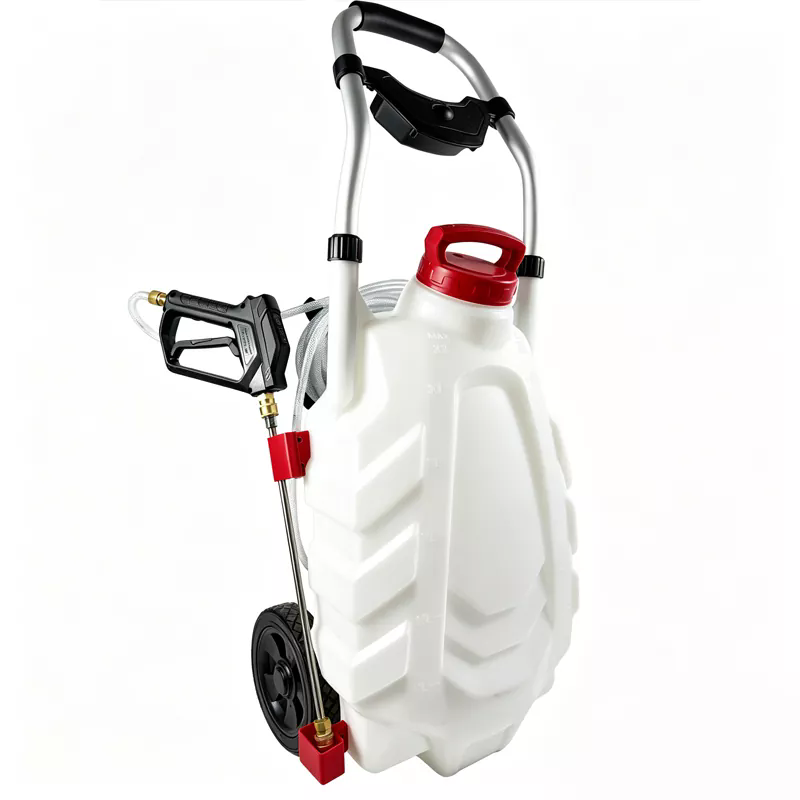
Table of Contents
- Understanding the 34L Wheeled Sprayer with Bluetooth
- What Problems Does It Solve?
- How Bluetooth Control Improves Spraying
- Why 34L Capacity Matters
- How the Lithium-Ion Battery Supports Daily Work
- How the Diaphragm Pump Supports Reliable Spraying
- How Wheeled Mobility Reduces Operator Fatigue
- Choosing the Right Spray Pattern
- Where the Sprayer Can Be Used
- Key Specifications at a Glance
- How to Use the Sprayer Efficiently
- Maintenance Practices for Longer Service Life
- What to Consider Before Choosing a Wheeled Sprayer
- Frequently Asked Questions
- Conclusion
Understanding the 34L Wheeled Sprayer with Bluetooth
Spraying large areas can become inefficient when equipment is difficult to transport, requires frequent refilling, or provides inconsistent pressure. These problems are particularly noticeable in orchards, vineyards, nurseries, greenhouses, agricultural fields, and commercial landscaping projects where operators may spend several hours moving between different treatment areas.
The 34L Wheeled Sprayer with Bluetooth from Crosstec is designed around these practical challenges. Instead of carrying a heavy tank on the operator's back, the unit is moved on wheels. Its 34-liter tank provides substantial liquid capacity, while a 20V lithium-ion battery powers the spraying system. Bluetooth wireless speed control allows the operator to adjust spraying output without repeatedly returning to the machine.
The system is designed with an industrial corrosion-resistant diaphragm pump, constant-pressure output, puncture-proof wheels, and interchangeable spray nozzles. According to the product specifications, the pump can provide a flow range of approximately 1.2 to 3.0 L/min, with working pressure adjustable within a range of approximately 0.5 to 6.6 bar.
This combination makes the machine useful when productivity, mobility, and controllable spraying performance are more important than simply having a basic manual sprayer.
What Problems Does It Solve?
Before selecting spraying equipment, it is useful to identify the operational problems that cause the greatest loss of time and effort.
- Frequent refilling: Small tanks require repeated stops, which can interrupt work.
- Operator fatigue: Backpack equipment places the weight of the liquid and machine directly on the user's body.
- Manual adjustment: Constantly walking back to the machine to change output can reduce productivity.
- Unstable spraying: Pressure fluctuations can make it difficult to maintain a consistent application.
- Limited mobility: Small wheels or pneumatic tires may perform poorly on rough agricultural surfaces.
- Battery limitations: Short operating time can create interruptions during larger projects.
- Maintenance concerns: Pumps and wheels exposed to demanding working conditions need durable construction.
A well-designed wheeled battery sprayer addresses these issues as part of one integrated system rather than treating them as separate equipment problems.
How Bluetooth Control Improves Spraying
One of the most practical features of the Crosstec 34L Wheeled Sprayer is its Bluetooth wireless control system. Spraying conditions are rarely identical throughout an entire work area. Dense vegetation, young plants, mature trees, narrow paths, and open ground may require different spray intensities.
With wireless variable-speed adjustment, the operator can change the spraying output from a distance instead of stopping work and returning to the machine.
- Adjust spray intensity according to the application area.
- Reduce output when treating delicate or smaller plants.
- Increase output when additional coverage is required.
- Reduce unnecessary liquid consumption.
- Minimize repeated movement between the operator and sprayer.
- Make spraying more convenient during extended working periods.
The benefit is not simply technological novelty. Wireless control can become a practical productivity feature when the operator is working around trees, long planting rows, greenhouse benches, or other areas where the equipment cannot remain directly beside the user.
Why 34L Capacity Matters
Tank capacity directly influences how often an operator needs to stop and refill. A 34-liter tank provides a useful balance between carrying sufficient liquid for larger jobs and maintaining a wheeled format that can be moved without placing the full load on the operator's back.
For commercial users, fewer refill cycles can simplify daily work planning. Instead of treating each small section as a separate spraying task, the operator can cover a larger area before returning to the mixing or filling station.
The chemical-resistant polyethylene tank is also intended for demanding spraying environments. However, users should always verify chemical compatibility with the tank, seals, hoses, pump, and other wetted components before introducing a new formulation.
| Capacity Consideration | Practical Benefit |
|---|---|
| 34L tank | Supports longer spraying sessions between refills |
| Wheeled design | Moves the liquid load instead of placing it on the operator |
| Chemical-resistant PE tank | Designed for demanding agricultural and sanitation applications |
How the Lithium-Ion Battery Supports Daily Work
Battery power removes many of the inconveniences associated with fuel-powered spraying equipment. The Crosstec system uses a 20V lithium-ion battery platform, with 2.6Ah and 5.2Ah configurations available according to the product specifications.
Depending on the battery configuration and operating conditions, the stated working time can reach approximately 45 to 105 minutes. Charging takes approximately 2.5 hours.
For operators, battery power provides several practical advantages:
- No fuel mixing or gasoline storage.
- No engine exhaust during operation.
- Convenient electric starting.
- Lower routine engine-related maintenance requirements.
- Suitable for enclosed or semi-enclosed working environments where engine exhaust is undesirable.
- Detachable battery design for convenient charging and handling.
Battery runtime should always be evaluated against the actual application. Higher pressure, greater flow, frequent speed changes, and continuous operation can influence energy consumption.
How the Diaphragm Pump Supports Reliable Spraying
The pump is one of the most important components of any powered sprayer. A high-capacity tank is of limited value if the pump cannot maintain the required pressure or handle the working fluid reliably.
The Crosstec 34L Wheeled Sprayer uses an industrial corrosion-resistant diaphragm pump. The stated specifications include a flow range of 1.2–3.0 L/min and pressure up to approximately 100 PSI.
Diaphragm pump technology is well suited to spraying applications because it can provide controlled liquid movement while being designed for demanding operating conditions. The product specification also indicates a pump life exceeding 1,000 hours under appropriate conditions.
Users should still follow correct operating procedures. Chemical compatibility, filtration, clean water flushing, storage conditions, and operating pressure all influence actual pump service life.
Practical Tip: Do not select pump pressure based only on the maximum specification. The correct setting depends on the crop, nozzle, spray distance, liquid formulation, and required coverage. Excessive pressure may create unnecessary mist and liquid loss.
How Wheeled Mobility Reduces Operator Fatigue
Spraying equipment can become physically demanding when operators must carry a large volume of liquid for long periods. A wheeled configuration changes the way the load is transported.
The 34L unit uses 8-inch puncture-proof wheels. Unlike conventional pneumatic tires, puncture-proof wheels do not require routine inflation and are less vulnerable to punctures caused by thorns, stones, and field debris.
This design is particularly useful for:
- Grass-covered agricultural areas.
- Orchard pathways.
- Vineyard rows.
- Gravel surfaces.
- Nursery environments.
- Uneven landscaping areas.
Although wheel performance depends on terrain and load, larger wheels generally make it easier to move equipment across surfaces where small caster-style wheels may become difficult to control.
Choosing the Right Spray Pattern
Different spraying jobs require different spray patterns. A single nozzle cannot provide optimal coverage for every application.
The Crosstec system supports interchangeable jet, fan, and mist nozzle options, allowing operators to adapt the spray pattern to the task.
| Spray Pattern | Typical Use | Key Consideration |
|---|---|---|
| Jet | Longer-distance or concentrated spraying | Useful where targeted reach is important |
| Fan | Broader surface coverage | Helps distribute liquid across wider areas |
| Mist | Fine coverage applications | Requires careful control to limit drift |
The best nozzle should be selected according to the treatment target and the instructions for the chemical being applied. Operators should avoid assuming that higher pressure or finer droplets always produce better results.
Where the Sprayer Can Be Used
A versatile wheeled sprayer can support a broad range of professional applications. The 34L format is particularly suitable where users need a combination of capacity, mobility, and controllable output.
- Orchards: Long-distance spraying can help reach higher vegetation and tree canopies.
- Vineyards: Wheeled mobility is useful when moving along repeated planting rows.
- Vegetable farms: Variable output can help adapt spraying intensity to different crops.
- Greenhouses: Battery operation avoids engine exhaust and simplifies starting.
- Nurseries: Different nozzle patterns can support different plant sizes and layouts.
- Landscaping: The unit can assist with maintenance of larger planted areas.
- Livestock facilities: It can be used for appropriate disinfection applications when the chemical and equipment compatibility requirements are satisfied.
- Public sanitation: A mobile powered sprayer can support selected large-area sanitation tasks.
Key Specifications at a Glance
| Specification | Crosstec 34L Wheeled Sprayer with Bluetooth |
|---|---|
| Tank Capacity | 34 L |
| Battery | 20V Lithium-Ion |
| Battery Options | 2.6Ah / 5.2Ah |
| Working Time | Approximately 45–105 minutes |
| Charging Time | Approximately 2.5 hours |
| Pump | Industrial corrosion-resistant diaphragm pump |
| Flow Rate | 1.2–3.0 L/min |
| Maximum Pressure | Approximately 6.6 bar / 100 PSI |
| Spraying Distance | More than 10 m |
| Vertical Reach | Approximately 5–6 m |
| Wheels | 8-inch puncture-proof wheels |
| Control | Bluetooth wireless variable-speed control |
| Nozzles | Jet, fan, and mist options |
How to Use the Sprayer Efficiently
Good equipment performance depends on correct operating practices. A practical workflow can help reduce waste and protect both the equipment and the operator.
- Inspect the machine: Check the tank, hoses, connections, nozzle, battery, and wheels before starting.
- Prepare the solution correctly: Follow the chemical manufacturer's mixing and handling instructions.
- Choose the nozzle: Select a spray pattern appropriate for the target and required coverage.
- Set an appropriate output: Begin with a moderate setting and adjust according to actual coverage.
- Maintain suitable distance: Keep the spray gun at a consistent working distance whenever possible.
- Use Bluetooth control: Adjust output without unnecessarily interrupting movement through the working area.
- Monitor the battery: Plan charging or battery replacement around the expected workload.
- Clean after use: Flush the system according to the chemical manufacturer's requirements.
Safety Reminder: Always follow the pesticide, fertilizer, disinfectant, or chemical manufacturer's instructions for dilution, personal protective equipment, application rate, storage, and disposal. A powered sprayer does not replace proper chemical-handling procedures.
Maintenance Practices for Longer Service Life
Regular maintenance is one of the simplest ways to protect spraying equipment from premature failure. Chemical residue, clogged filters, damaged seals, and poor battery storage can all reduce performance.
- Flush the tank and liquid circuit after compatible applications.
- Clean nozzles carefully to prevent partial blockage.
- Inspect hoses and connections for leaks.
- Check the spray gun and seals for signs of wear.
- Keep the pump system free from unnecessary chemical residue.
- Inspect puncture-proof wheels and frame components regularly.
- Store the battery according to the battery manufacturer's recommendations.
- Keep electrical connectors clean and dry.
- Do not leave incompatible chemicals inside the tank for extended periods.
Maintenance intervals should be adjusted according to frequency of use, chemical exposure, water quality, operating environment, and storage conditions.
What to Consider Before Choosing a Wheeled Sprayer
Capacity alone should not determine which sprayer is right for a business or professional application. Buyers should evaluate the complete operating system.
| Buying Factor | Questions to Ask |
|---|---|
| Tank Capacity | How much area must be treated before refilling? |
| Battery | Is the runtime sufficient for a normal work session? |
| Pump | Can it provide the required flow and pressure? |
| Chemical Compatibility | Are wetted components compatible with the intended solution? |
| Mobility | Can the wheels handle the actual working terrain? |
| Control | Can output be adjusted conveniently while working? |
| After-Sales Support | Are spare parts, technical support, OEM, or ODM services available? |
For distributors and agricultural equipment brands, supplier capability is also important. Crosstec states that it provides OEM and ODM services and has experience in lithium-powered spraying equipment. These services can be useful when buyers need customized product configurations, private-label solutions, or equipment adapted to specific markets.
Frequently Asked Questions
1. What is a 34L Wheeled Sprayer with Bluetooth?
A 34L Wheeled Sprayer with Bluetooth is a mobile battery-powered sprayer with a 34-liter liquid tank and wireless control functionality. The Bluetooth system allows the operator to adjust spraying output remotely, while wheels make the machine easier to move than a comparable backpack-style system.
2. How far can the Crosstec 34L Wheeled Sprayer spray?
The product specifications indicate a spraying distance of more than 10 meters and a vertical spray height of approximately 5–6 meters, depending on operating conditions, nozzle selection, pressure, and application technique.
3. How long does the battery last?
Depending on the selected battery capacity and operating conditions, the stated working time is approximately 45–105 minutes. Actual runtime can vary according to flow rate, pressure, terrain, and usage pattern.
4. Is the wheeled design better than a backpack sprayer?
Neither design is universally better. A backpack sprayer may be convenient for narrow or highly irregular spaces, while a wheeled sprayer can reduce the physical burden of carrying a large liquid load. For larger treatment areas, the wheeled configuration can be especially useful.
5. What types of applications are suitable for this sprayer?
The system is designed for applications including orchards, vineyards, farms, nurseries, greenhouses, landscaping, agricultural treatment, livestock-facility disinfection, and selected sanitation projects.
6. Can the spraying speed be adjusted?
Yes. The Bluetooth wireless variable-speed control allows operators to adjust the spraying output remotely, helping them adapt the application to changing working conditions.
7. Are puncture-proof wheels useful for agricultural work?
Yes. Puncture-proof wheels eliminate the need for inflation and reduce the risk of flat tires caused by thorns, stones, and other field debris. Their usefulness is particularly noticeable on grass, gravel, and uneven agricultural paths.
8. Does Crosstec support OEM and ODM orders?
Yes. Crosstec states that OEM and ODM services are available for distributors, importers, agricultural equipment companies, and brands seeking customized solutions.
9. How should the sprayer be cleaned after use?
The tank, hoses, pump circuit, spray gun, and nozzles should be cleaned according to the chemical manufacturer's instructions. Appropriate flushing and storage procedures help reduce residue buildup and protect the spraying system.
10. What should buyers check before using a new chemical?
Users should verify compatibility between the chemical formulation and every wetted component, including the tank, pump, seals, hoses, and nozzle. The chemical manufacturer's application and safety instructions should always take priority.
Conclusion
A modern sprayer needs to solve real operational problems rather than simply provide higher pressure. The 34L Wheeled Sprayer with Bluetooth brings together several features designed for professional spraying: a 34-liter chemical-resistant tank, 20V lithium-ion power, wireless variable-speed control, constant-pressure operation, an industrial diaphragm pump, puncture-proof wheels, and interchangeable spray patterns.
For operators managing orchards, vineyards, farms, greenhouses, nurseries, landscaping projects, and selected sanitation applications, this combination can reduce physical strain, minimize unnecessary interruptions, and provide greater control over spraying operations.
Crosstec focuses on lithium-powered spraying equipment and offers product solutions for professional users as well as OEM and ODM customers. Choosing the right configuration should always begin with the actual application, required spray rate, terrain, chemical compatibility, expected runtime, and maintenance requirements.
Looking for a Reliable Wheeled Spraying Solution?
If you are sourcing a professional 34L Wheeled Sprayer with Bluetooth for agricultural, landscaping, sanitation, or distribution applications, Crosstec can provide product information and OEM/ODM support to help you evaluate the right solution. Contact us to discuss your application requirements, battery configuration, spraying needs, and customized equipment options.